ESL jobs Asia are attracting educators from around the world — and for good reason. South Korea alone offers a vibrant cultural experience, competitive salaries, and a student population hungry for global connection. Yet the most rewarding aspect of teaching English abroad isn’t found in a guidebook. It’s found in the moment a shy student finally raises their hand, no longer afraid to make a mistake.
This guide covers everything prospective teachers need to know about Social Emotional Learning (SEL) in ESL jobs Asia — from classroom strategies to school selection, qualifications, and salary expectations. If you are searching for English teaching jobs in Asia that offer genuine professional fulfilment, read on.
1. Why South Korea’s Academic Environment Creates a Critical Need for SEL
South Korea’s education system ranks among the most rigorous in the world. Students routinely spend fourteen hours per day in study — attending mainstream school by day and private tutoring academies, known as hagwons, by evening. While this drives exceptional academic results, it leaves little room for emotional development or self-expression.
This is precisely the gap that ESL jobs Asia are uniquely positioned to fill. Educators arriving from abroad bring a pedagogy that treats the whole child — not just the test score — as the measure of success. According to South Korea’s Ministry of Education, the national Character Education initiative formally aligns with SEL principles, giving foreign teachers institutional backing for this approach.
2. What Is Social Emotional Learning (SEL)?
SEL is the structured process by which children and adults develop the knowledge, skills, and mindset to manage emotions, build relationships, and make responsible decisions. In the context of English language instruction, SEL is both a teaching philosophy and a practical toolkit.
Core SEL competencies include:
- Self-awareness: Recognising personal emotions and their effect on behaviour
- Self-management: Regulating emotions and impulses, particularly under academic pressure
- Social awareness: Understanding and empathising with peers from diverse backgrounds
- Relationship skills: Communicating effectively, resolving conflict, and collaborating
- Responsible decision-making: Evaluating consequences and making ethical, constructive choices
For educators holding ESL teaching positions across Asia, these competencies translate directly into classroom activities — from collaborative group projects to reflective journaling in English.
3. Why ESL Jobs in Asia Are the Ideal Platform for SEL Integration
The English Classroom as a Low-Stakes Environment
English is a secondary language for Korean students. This creates a natural psychological buffer: errors feel less consequential here than in core academic subjects. ESL educators across Asia can capitalise on this dynamic to establish classrooms where emotional honesty and intellectual risk-taking are actively encouraged.
Building Globally Competitive Citizens
Empathy, resilience, and self-regulation are not supplementary skills — they are core competencies in today’s globalised economy. English teachers in South Korea who embed SEL into instruction are preparing students for university environments and workplaces that increasingly demand emotional intelligence alongside technical expertise.
Improved Classroom Management Through Connection
A student who feels understood is a student who participates. Research consistently links SEL implementation to reduced behavioural disruptions and increased academic engagement. For professionals in ESL roles throughout Asia, this translates directly into more effective and more fulfilling lessons.
4. 7 Proven SEL Strategies for ESL Classrooms in Asia
Strategy 1 — The Daily Mood Meter
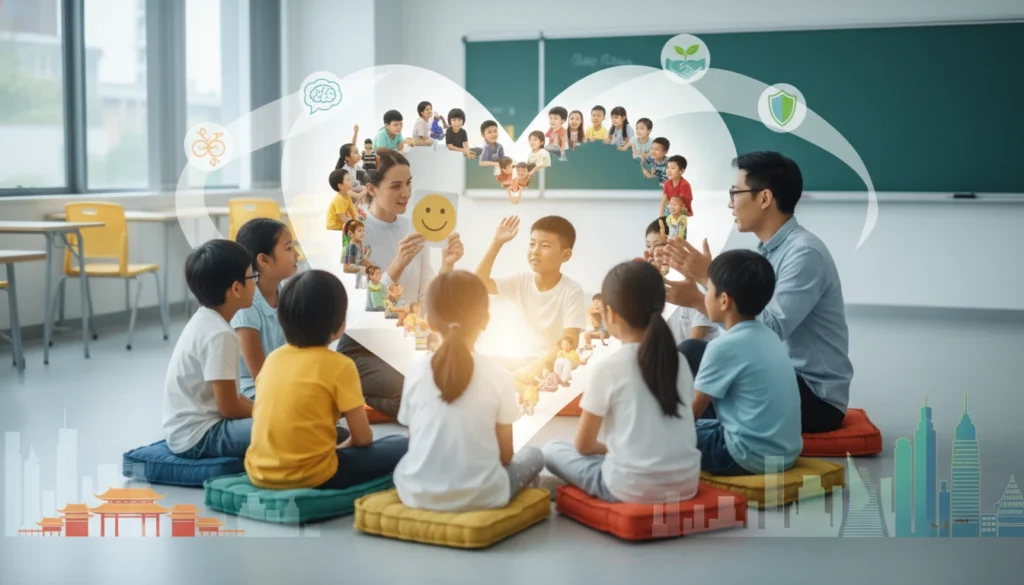
At the start of each lesson, students select an emoji or colour representing their current emotional state. This activity builds emotional vocabulary in English while giving ESL educators in Asia an immediate, actionable read on the room before instruction begins.
Strategy 2 — The Gratitude Circle
Before closing each lesson, students share one thing they are grateful for — in English. This brief ritual consistently shifts classroom energy away from exam anxiety and toward community and appreciation. Over time, it builds both fluency and emotional regulation simultaneously.
Strategy 3 — Resilience-Based Reflective Journaling
Structured journal prompts centred on growth mindset, resilience, and self-compassion give students dual value: written English practice and an emotional processing outlet. This is one of the most scalable tools available to English teachers across Asia.
Strategy 4 — Collaborative Group Projects
Team-based tasks require students to negotiate roles, manage disagreement, and produce shared outcomes — all in English. These activities develop the interpersonal competencies that Korean education’s individual-performance model often underserves.
Strategy 5 — Mistake-Friendly Modelling
When teachers openly make and acknowledge mistakes in front of students, they actively dismantle the fear of failure. This is a high-impact, zero-cost intervention that redefines classroom culture from performance anxiety to psychological safety.
Strategy 6 — Emotion-Based Vocabulary Units
Design thematic vocabulary units around emotions: describing feelings, navigating conflict, expressing needs, and offering encouragement. This approach aligns language acquisition directly with SEL competencies and is particularly effective in ESL contexts across South Korea and broader Asia.
Strategy 7 — Active Listening Circles
In pairs or small groups, students take turns speaking uninterrupted for sixty seconds while partners listen without responding. The debrief — conducted in English — practises both comprehension and the foundational SEL skill of attentive listening.
5. Real Impact: A Classroom Story
Ji-hoon was academically exceptional but emotionally brittle. His parents’ expectations had made him deeply averse to error. Through resilience-focused activities integrated across several weeks of English lessons, he began to separate linguistic mistakes from personal failure. That reframing — small in theory, transformative in practice — is the kind of legacy that defines a career in ESL teaching across Asia.
Ji-hoon’s story is not exceptional. It represents what becomes possible when ESL professionals in Asia approach their classrooms with both linguistic expertise and emotional intelligence.
6. How to Find ESL Jobs in Asia That Prioritise Student Wellbeing
Not every teaching institution is equal in its commitment to holistic development. When evaluating ESL job opportunities in Asia, look for these indicators:
- Explicit mention of student-centred or holistic learning frameworks in the school’s curriculum documentation
- Formal alignment with South Korea’s Character Education initiative — a Ministry of Education programme that directly supports SEL principles
- Teacher professional development that includes wellbeing, culturally responsive pedagogy, or social-emotional frameworks
- Strong staff retention and positive educator testimonials referencing school culture and support structures
Specialist ESL recruitment platforms for Asia — including eslteachingjobinasia.com — allow candidates to filter for school profiles that demonstrate these commitments. Use keyword searches such as “student-centred,” “holistic,” and “character education” to identify well-aligned opportunities.
7. Qualifications for ESL Jobs in Asia
Entry requirements for English teaching roles in South Korea are standardised and accessible for most degree-holding graduates:
- Bachelor’s degree in any subject — required for work visa eligibility in South Korea
- TEFL or CELTA certification (120-hour minimum; 180-hour preferred for competitive positions)
- Native or near-native English proficiency (citizenship requirements vary by employer and visa category)
- Clean criminal background check (mandatory for all Korean school placements, both public and private)
No psychology qualification is required to implement SEL effectively. The approach is fundamentally one of pedagogical mindset — the empathy and intentionality you bring to your role as an ESL educator in Asia is what matters most.
Frequently Asked Questions: ESL Jobs in Asia and Social Emotional Learning
Do I need specialist training to implement SEL in my ESL classes?
No formal SEL certification is required for the majority of ESL teaching positions across Asia. A TEFL qualification combined with a student-centred mindset provides a strong foundation. Many educators deepen their SEL practice through in-service professional development once placed in their school.
Are Korean schools receptive to SEL-informed teaching methods ?
Yes. The Korean Ministry of Education has formally integrated Character Education — directly aligned with SEL principles — into the national curriculum framework. Both public schools and progressive private academies actively welcome educators who demonstrate this approach.
How competitive is the market for ESL jobs in Asia right now ?
Demand for qualified English teachers across South Korea and broader Asia remains strong in 2024, particularly for candidates who can demonstrate both language instruction competency and student wellbeing awareness. Schools increasingly differentiate on culture and teacher quality, making SEL-informed applicants highly sought after.
What salary can I expect from ESL teaching roles in South Korea ?
Compensation packages for ESL jobs in South Korea typically include:
- Monthly salary of KRW 2.0–3.2 million (approximately USD 1,500–2,400 depending on school type and experience)
- Free or subsidised housing (standard across most public school and hagwon contracts)
- Return flight reimbursement on contract completion
- National health insurance contributions and completion bonuses
Public school positions through programmes such as EPIK offer standardised packages, while private hagwons may offer higher base salaries with variable benefits. For current listings with transparent package details, visit eslteachingjobinasia.com.
Conclusion: Your Legacy Through ESL Jobs in Asia
Choosing one of the many ESL jobs in Asia is one of the most professionally and personally rewarding decisions an educator can make. South Korea’s students are among the most academically pressured in the world. They need teachers who see beyond the curriculum — who ask not only “Can you conjugate this verb?” but “How are you feeling today?”
By integrating Social Emotional Learning into your ESL teaching practice across Asia, you contribute to a more emotionally literate, resilient, and empathetic generation. The grammar worksheets will be forgotten. The confidence you instilled in a student who finally felt understood — that endures.
Ready to make a difference? Explore the latest ESL teaching opportunities in South Korea and across Asia and take the first step toward a career defined by genuine impact.

