Whether you are logging in from a digital nomad hub in Bali or navigating the bustling subway systems of Beijing, teaching English as a Second Language is rarely just about grammar and vocabulary. It is a crash course in cultural adaptability, patience, and reading the room—even if that room is virtual. ESL work environment Asia
If you’re considering taking the leap, or if you’ve just landed and are wondering why your co-teacher won’t look you in the eye, this guide is for you. Let’s peel back the layers of the ESL industry, from the isolation of online teaching to the high-context cultures of Korea and China.
The Digital Classroom It’s More Than Just a Ring Light
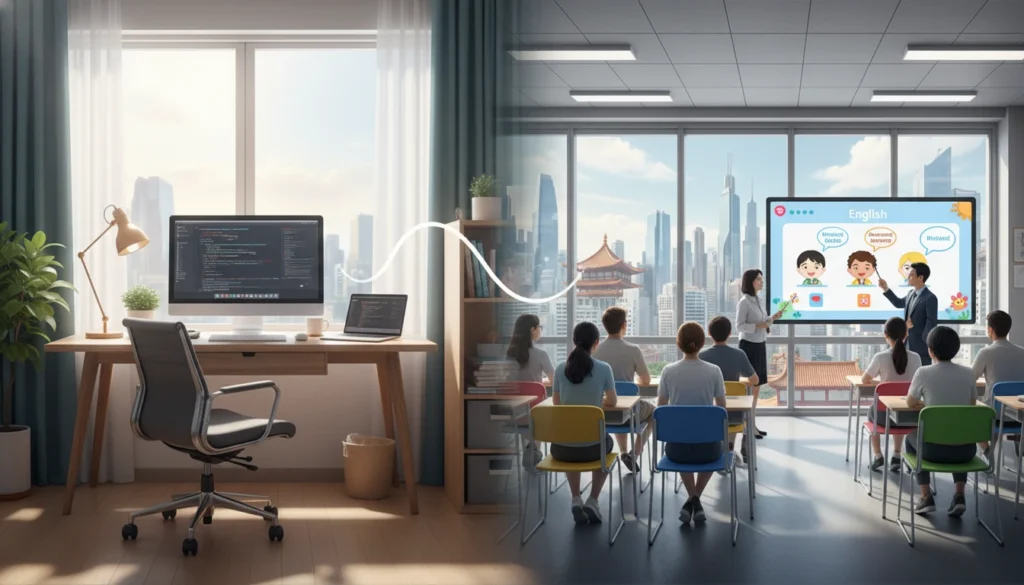
Before we hop on a plane, let’s talk about the sector that exploded over the last few years: Online ESL. It seems like the dream gig. No commute, coffee on tap, and total location independence. But the online work environment has its own unique ecosystem.
The Energy Drain is Real: In a physical classroom, you can feed off the students’ energy. Online? You are the energy source. You are essentially a children’s TV show host. The work culture here is solitary but demanding. Platforms often use algorithm-based bookings, meaning your “boss” is a computer program that ranks you based on punctuality, lighting quality, and parent ratings.
The Setup Matters:
– Lighting: You aren’t just a teacher; you’re a broadcast production.
– Props: Your background is your classroom. A blank wall screams “amateur,” while a colorful backdrop says “professional.”
– Tech Reliability: If your internet cuts out, you don’t just lose a few minutes; you often lose pay.
South Korea The ‘Palli Palli’ Pressure Cooker
Teaching English in Korea culture, you are entering a society built on rapid modernization and intense education fever. The Korean phrase “Palli Palli” (Hurry, Hurry) isn’t just for food delivery; it permeates the ESL work environment Asia.
Hagwons vs. Public Schools: Your experience will differ vastly depending on your employer.
– The Public School (EPIK): Here, you are a civil servant. The vibe is bureaucratic but stable. You likely have a co-teacher who manages the discipline while you handle the “fun” English parts. The hierarchy is strict, but the hours are generally 9-to-5.
– The Hagwon (Private Academy): This is where most new teachers land, and it is a business first, school second. The Hagwon culture is fast-paced. Parents are clients, and students are the product. You might feel pressure to ensure students get high test scores or simply “look happy” to keep mom and dad paying tuition.
However, the money can be better. Hagwons often pay more for the increased intensity. But be warned: the schedule can be grueling, often running late into the evening.
The Social Dynamic: Korea is a collective society. You will be expected to attend Hwesik (company dinners). These aren’t optional in the cultural sense. This is where bonds are forged over Korean BBQ and Soju. Refusing can be seen as rejecting the team. It’s in these moments that the rigid hierarchy softens slightly, and you truly become part of the staff.
China: The Art of ‘Face’ and Flexibility
Crossing the Yellow Sea to China, the scale changes, and so do the rules. The teaching of English in China’s work culture is dominated by one massive, invisible force: Face (Mianzi).
Understanding ‘Face’: In the West, we value directness. “Hey, you made a mistake on the schedule.” In China, saying that publicly to a manager is a career death sentence. You have caused them to lose face.
According to the cultural dimensions of hierarchy, China has a high power distance. Criticism must be subtle, private, and cushioned with praise. Conversely, if a school promises you something and fails to deliver, they might dance around the topic to avoid admitting failure (losing their own face).
The ‘Cha Bu Duo’ Attitude: While Korea is ‘Hurry Hurry,’ China often operates on Cha Bu Duo (Close Enough). Schedules change last minute. A class might be cancelled ten minutes before it starts, or a holiday might be announced the day before.
For a Type-A Westerner, this is infuriating. For a seasoned expat, it’s Tuesday. The key to surviving the Chinese work environment is flexibility. If you can roll with the punches, you will thrive. If you demand rigid adherence to a plan, you will burn out.
Training Centers vs. International Schools: Similar to Korea, there is a divide.
– Training Centers: Evening and weekend hours. Sales-driven. High energy.
– International Schools: Western hours. High academic standards. Requires valid licensure.
Regardless of where you teach, ensuring you are securing your Z visa for China is the first test of your school’s legitimacy. If they ask you to work on a tourist visa, run. That is a work environment that does not value your legal safety.
The Universal Struggle: Office Politics & Hierarchy
Whether in Seoul, Shanghai, or on Skype, there are soft skills you need to master.
1. The Hierarchy is Absolute: In Confucian cultures, age and title matter more than competency. You might have a Master’s degree in Education, but if the head teacher (who has been there 20 years) tells you to teach a certain way, you listen. You can suggest changes, but you must do so with extreme humility.
2. Desk Warming: This is the bane of the ESL teacher’s existence, particularly in Korea. You have no classes for three hours. You have finished your lesson planning. Can you go home? No. You must sit at your desk. It is about presence. Being seen working is often as important as the work itself.
3. Appearance Matters: In Asia, judging a book by its cover is standard practice. Teachers are expected to look the part. Visible tattoos should often be covered, and “business casual” is the baseline. In the online world, this means looking bright-eyed and bushy-tailed even if it’s 3 AM in your time zone.
Practical Survival Tips for the ESL Workplace
1. Learn the Language (Just the Basics): You don’t need to be fluent. But knowing how to say “Hello,” “Thank you,” and “I’m sorry” in Korean or Mandarin buys you immense goodwill. It shows you respect their culture.
2. Find Your Tribe: The foreign teacher room is your sanctuary. Vent there, but never vent to local staff about local staff.
3. Read the Contract: Before signing, understand the sick leave policy and the notice period. Contract disputes are common, but preventable.
4. Smile: It sounds cheesy, but in high-context cultures, a smile diffuses tension better than an argument.
Conclusion: Embracing the Chaos
Navigating the ESL work environment Asia is not a linear path. It is a squiggly line full of mistranslations, last-minute schedule changes, and moments of profound connection with students that you will remember for the rest of your life.
You will learn that “Yes” doesn’t always mean “Yes” (it might mean “I hear you, but no”). You will learn that a gift of fruit from a parent is the highest compliment. And you will learn that whether you are in a digital classroom or a physical one, the core of the job remains the same: connecting with a human being who wants to learn.
So, pack your bags (or set up your ring light), keep your mind open, and maybe verify the living costs in Shanghai vs. Seoul before you pick your destination. The adventure is worth the culture shock.


 English
  Korean