
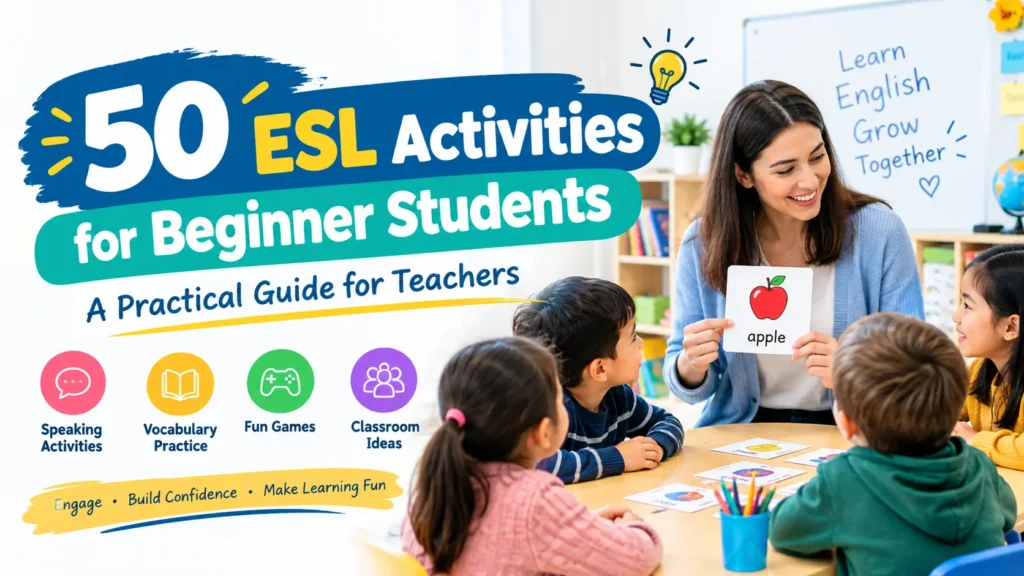
50 ESL Activities for Beginner Students: A Practical Guide for Teachers
Stepping into a classroom in Seoul or Shanghai for the first time can be daunting. You look out at faces that are eager but unsure, and you realize that your primary goal is to bridge the language gap. Finding the right ESL activities for beginner students is the difference between a classroom of confused learners and one buzzing with linguistic potential. Whether you are teaching young children or adults, building a repertoire of beginner ESL activities is essential for any teacher navigating the Asian education landscape.
Why Engaging ESL Activities for Beginner Students Matter
Beginners often struggle with confidence. They fear making mistakes, which can lead to silent, static classrooms. By utilizing ESL classroom activities for beginners, you lower the affective filter, making students feel safe enough to experiment with new sounds and structures. These English activities for beginners aren’t just filler; they are the scaffolding upon which fluency is built. When you incorporate fun ESL activities for beginners, you transform the learning experience from a chore into a highlight of their day.
Warm-up and Icebreaker Games
1. Name Toss: Use a soft ball; say your name, then toss it to a student.
2. The Mingle: Students walk until the music stops, then introduce themselves to the person next to them.
3. Quick Introductions: A fast-paced version of ‘Two Truths and a Lie.’
4. Simon Says: A classic for teaching body parts and action verbs.
5. Find Someone Who: A scavenger hunt where students find peers with specific hobbies.
6. Circle Time Greetings: Rotate around the room with different greetings.
7. Picture Guessing: Show a hidden image and let them guess the word.
8. Color Dash: Shout a color and students must touch something of that color.
9. Number Bingo: Great for teaching numeracy and listening.
10. Human Statue: One student acts out an emotion, others guess.
Speaking and Communication Activities
ESL speaking activities for beginners are vital. Since the target language is new, focus on sentence frames rather than complex grammar.
11. Show and Tell: Let students bring an item from home.
12. Role Play – Cafe: Practicing ordering food.
13. Role Play—Hospital: Describing simple ailments.
14. Interview the Teacher: A great way to practice question structures.
15. Picture Storytelling: Use a sequence of cards to tell a basic story.
16. Telephone Game: Encourages careful listening and pronunciation.
17. Talk in Pairs: Simple ‘What is your favorite X?’ prompts.
18. Sentence Starters: Give a phrase like ‘I like…’ and let them finish.
19. Opinion Poll: Do you like cats? Yes/No.
20. Action Charades: Acting out verbs instead of saying them.
Vocabulary Building and Retention
Effective ESL vocabulary activities for beginners must prioritize repetition through play.
21. Flashcard Slap: Two students race to slap the card called out.
22. Memory Match: Turn cards face down and find the pairs.
23. Word Walls: Keep vocabulary visible at all times.
24. Categorization: Sort cards into groups (e.g., fruit vs. animals).
25. The Spelling Bee (Beginner Edition): Focus on CVC words.
26. Pictionary: Drawing the vocab word on the board.
27. Missing Card: Hide one card and ask ‘What is missing?’
28. Word Hunt: Hide words around the room.
29. Labeling the Classroom: Put sticky notes on objects.
30. Alphabet Bingo: Focus on phonic sounds.
Movement-Based Activities (TPR)
31. Total Physical Response (TPR): The Teacher says ‘Jump,’ and students jump.
32. Dance and Stop: Dance to English music, freeze on command.
33. Yoga for ESL: Use specific commands to move into poses.
34. Animal Walk: Act like animals while saying the names.
35. Follow the Leader: Mimic the teacher’s actions and words.
36. Scavenger Hunt: Find objects of a specific color.
37. Musical Chairs (Vocabulary Edition): Sit on a card, say the word.
38. Pass the Parcel: Simple questions inside layers.
39. Balloon Pop: Pop a balloon for a question task.
40. Line Up: Line up by height, birthday, or favorite food.
Low-Prep Ideas for Busy Teachers
Sometimes you need ESL games for beginners that don’t require an hour of prep.
41. Board Races: Two teams race to write a word on the board.
42. Back-to-Back Drawing: Describe an image to a partner.
43. Dictation Races: Run to the board and write what the teacher reads.
44. Hangman (Simplified): Focus on vocabulary review.
45. I Spy: ‘I spy with my little eye something blue.’
46. What’s in the Bag? : Feeling an object and guessing it.
47. 20 Questions: A slightly more advanced version for high-beginners.
48. True or False: The teacher makes statements; students respond.
49. Story Chain: Each student adds one word to a sentence.
50. Final Review Quiz: A quick exit ticket challenge.
Conclusion Making Learning Stick
As you integrate these ESL activities for beginner students into your lessons in China or Korea, remember the goal is not perfection, but participation. By choosing the right ESL activities for beginner students for the specific age and level of your class, you set the stage for long-term success. Keep it simple, keep it high-energy, and watch your students flourish.

